NBA Best Player Prop Bets — A UK Punter’s Research Guide
Hit-rate research and vig-stripped value, UK punters first.
 Available in US
Twelve years ago I stood in a Vilnius café trying to explain to a friend why a £10 punt on Carmelo Anthony scoring over 24.5 points was a different animal from a punt on the Knicks beating the Bulls. He nodded politely and lost the bet. The lesson stuck with me — not because of his £10, but because the bookmaker had quietly priced that line so tight that even with a brilliant performance from Melo we were a coin-flip away from a push. Player props look like the friendliest corner of the basketball board. They’re also the place where careless punters lose money fastest.
This guide is written from a UK chair. That matters more than it sounds. The vast majority of NBA prop content online is American — same-game parlays priced in –110, sportsbook brand names that don’t operate here, and no mention of the UK Gambling Commission, the statutory levy that just went live, or the Remote Gaming Duty rise scheduled for April 2026. UK punters have to translate twice: from American odds to decimal, and from the US regulatory frame to the UKGC one.
I’ll do that translation throughout. We’ll cover the maths of vig, the markets where hit rates favour the over and the ones where unders quietly lead, the injury-report window that became the most valuable two hours of any NBA day after the October 2025 scandal, and the practical state of player-prop coverage across UKGC-licensed bookmakers. You won’t find a “pick of the day” here. What you will find is a research framework you can run before any prop you fancy — and the data to know whether the line you’re staring at is roughly fair or quietly poor.
For context on scale: the UK online betting industry is enormous, with gross gambling yield reaching £16.8 billion in the financial year ending March 2025 and growing 7.3 percent year on year. Player props now account for an estimated 25 to 30 percent of all basketball handle in 2025, up from roughly 15 percent only three years earlier. That’s the wave you’re paddling into.
Table of Contents
- Six numbers and one habit that change how you bet NBA props
- What player props actually are when you bet from a UK account
- The market menu — what UK bookmakers actually post
- Hit-rate landscape — which markets cash and which don’t
- Vig, overround and where value actually hides
- The five-factor research framework I run before every prop
- Injuries, scratches and how settlement actually works
- Integrity, the 2025 scandal and why some props vanished
- UKGC rules, the statutory levy and the 2026 duty rise
- How UK bookmakers cover NBA — the practical landscape
- Betting NBA responsibly when you live in the UK
- Questions UK punters keep asking me about NBA props
- The pre-tip-off routine I'd hand a friend starting today
Six numbers and one habit that change how you bet NBA props
- Hit rates vary sharply by market: blocks 69.9 percent, threes 63.2 percent, steals 61.9 percent, assists 57.6 percent, rebounds 57.3 percent, points 55.7 percent — pick markets where the work pays off rather than betting points by default.
- The standard –110/–110 prop carries 4.8 percent overround in decimal (1.91/1.91); your projection has to clear 52.4 percent for the bet to make money.
- NBA’s 11:00 to 13:00 injury-report window introduced after the October 2025 scandal is the highest-EV two hours of any game day for prop research.
- The UK statutory levy (£120 million annually) and the Remote Gaming Duty rise to 40 percent in April 2026 will tighten operator margin and likely widen vig on lower-handle markets.
- Run the five-factor routine on every prop: minutes, usage rate, pace, defensive matchup, line shopping. Skipping any single step is where casual punters bleed money.
What player props actually are when you bet from a UK account
A punter once asked me, perfectly seriously, whether a player prop was the same as backing a player to be man of the match. It isn’t, but the confusion makes sense — both feel like betting on a person rather than on the scoreboard. Player props pin the bet to a specific stat line for a specific player, regardless of who wins or loses the game.
The cleanest definition: a player prop is a wager on whether a named player’s individual statistical output will land over or under a published line during a specific match. Most are over/under markets, posted as a number with two prices either side. Will LeBron go over 24.5 points? Will Luka clear 8.5 assists? Did Wembanyama see four or more blocks? Each is a player prop. The match result is irrelevant — the player can be on the losing team and still cash a winning ticket.
Player prop — a wager on an individual player’s stat total in a single game, usually offered as over/under against a published line, settled on the player’s actual production rather than on the match outcome.
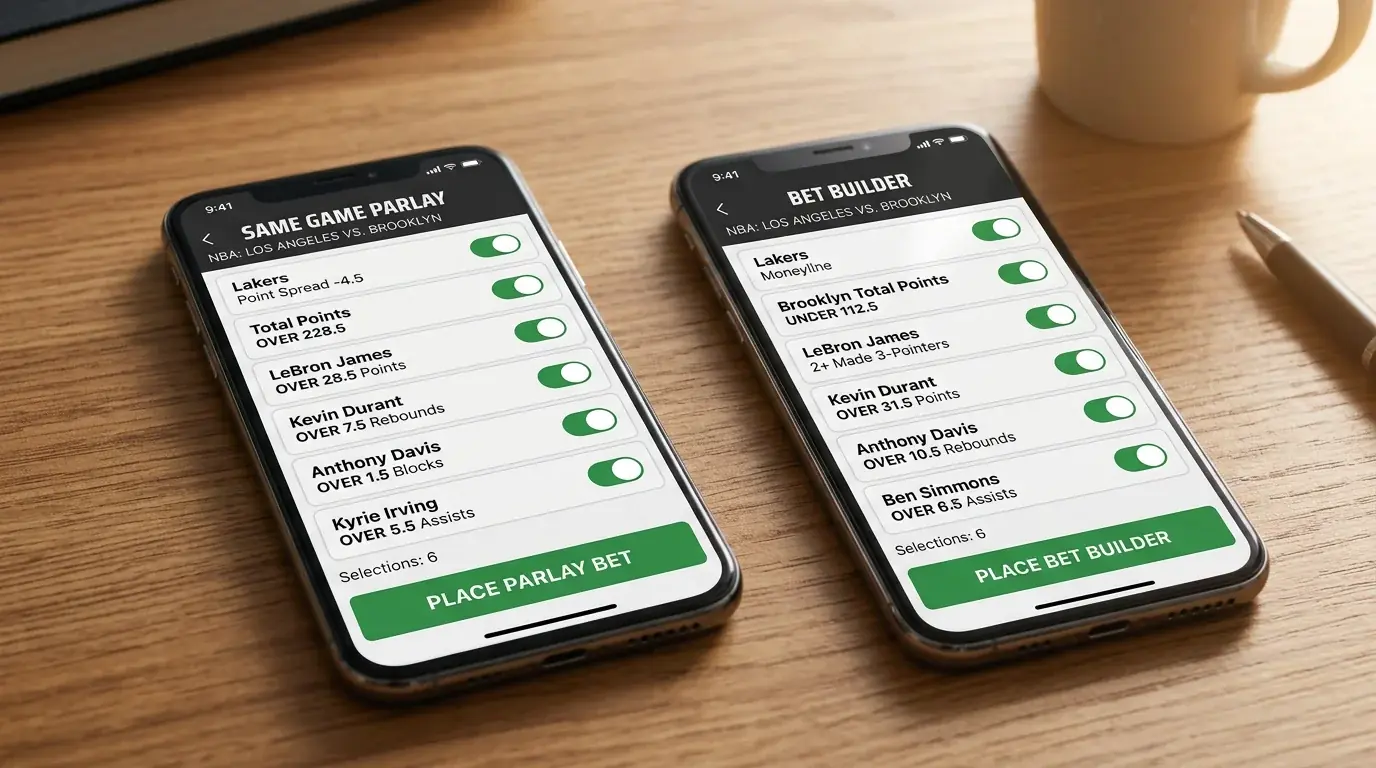
From a UK angle, three terminology shifts matter. American sources call the operator a “sportsbook”; we call it a UKGC-licensed bookmaker. Americans price props at –110/–110; UK accounts show the same prices as 1.91/1.91 in decimal. And what the United States calls a “same-game parlay” — multiple selections from the same match in one ticket — your UK account labels a “bet builder”. The maths is identical, the names are not. Sportsbook trader Scott Seidenberg captured the scale when he noted prop handle was hitting 40 to 50 percent of NBA volume in some American states, with thousands of different player-prop options on any given night.
The reason this matters before any maths: UK punters often run into Reddit threads and YouTube tipsters using the American framing without translation. If you don’t know that “the under hit at –115” and “the under was priced at 1.87” are the same sentence in two languages, you’re half-blind to the actual edge being discussed. Decimal odds also make vig calculation considerably easier, and we’ll lean into that later.
Roughly 8 percent of UK adults reported placing an online or app-based sports bet in the last four weeks during Wave 3 of the Gambling Commission’s participation survey, covering July to October 2025. Basketball is a niche sport in the UK relative to football and horse racing, so the punter base for NBA props is a fraction of a fraction. Liquidity is thinner than in the US, with consequences for prop pricing we’ll come back to in the bookmaker section.
Note: Whenever this guide says “the line”, it means the published number you’re betting over or under. “The price” or “the odds” means the decimal coefficient attached to each side of that line.
The market menu — what UK bookmakers actually post
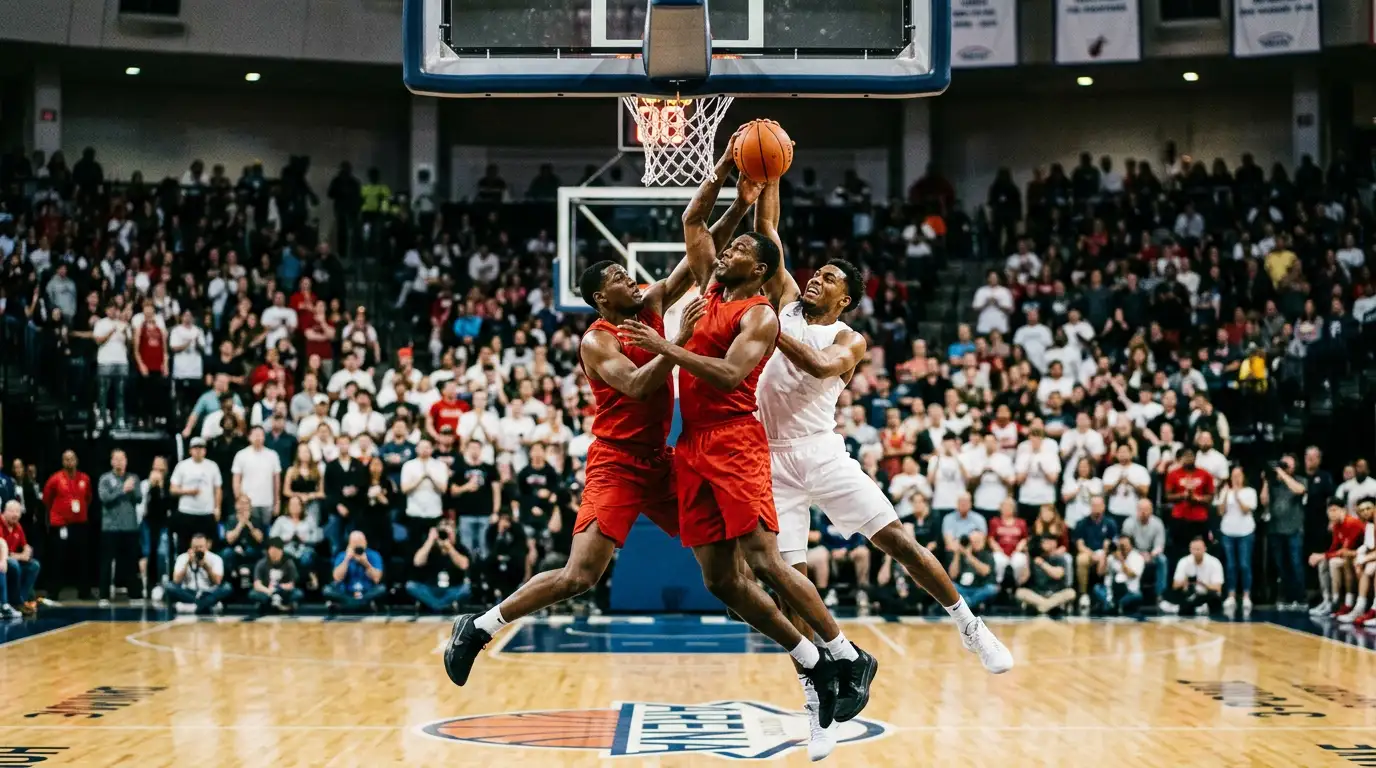
Open any UKGC-licensed bookmaker on a Tuesday evening in February and you’ll see something faintly absurd: a single NBA match between two unremarkable teams will have over two hundred prop lines posted against it. Multiply by the seven or eight games on a typical slate. The maths gets ugly fast.
Industry research puts the figure at roughly 200 to 250 individual prop lines per game day during the 2025–26 season, totalling more than 250 000 unique prop markets across a regular-season campaign. Most of those lines never get serious money — they exist because automated trading systems can post them — but the breadth means you can almost always find a market that fits a research angle you’ve genuinely thought about.
Volume snapshot, 2025–26 regular season
Roughly 200–250 prop lines posted per game day. More than 250 000 unique prop markets across the regular season. Points over/under accounts for an estimated 35–40 percent of all prop handle at major operators.
Single-stat over/under markets
Points, rebounds, assists, three-pointers made, steals, blocks. Each gets its own line per player. Points dominates handle because scoring is what casual fans watch; threes and blocks attract sharper money because their distributions are easier to model and the lines are often softer.
Combined-stat markets
The big ones are points plus rebounds plus assists, usually written PRA, and points plus rebounds. These markets reduce variance for the bettor: a star can have a quiet scoring night and still cover PRA on the back of assists. They suit primary playmakers — your Lukas, your Brunsons, your Trae Youngs — far better than catch-and-shoot wings.
Yes/no milestone markets
Double-double yes/no, triple-double yes/no, “to record at least one block” markets. These are binary outcomes priced like coin flips with strong skews — the “no” on a triple-double for most stars sits around 1.20 to 1.30 in decimal, because triple-doubles are genuinely rare. Useful when you have a strong lean. Dangerous when you don’t.
Alt-line ladders
An alt-line is the same stat with a shifted number. If the standard points line is 22.5, the bookmaker will offer 19.5, 25.5, 28.5 and 31.5 with progressively more generous prices. Alt-lines reward strong directional opinions and punish shapeless flair-bets where you only chose the line because the price looked tasty.
Race-to-X and game-state markets
Race-to-X is less common in UK menus than in US ones, but the major UKGC books post them on premium games. First-basket and game-state props carry some of the heaviest margin on the entire NBA board — overround on a first-basket market commonly sits in double digits. Treat these as entertainment, not as a value pool.
The American Gaming Association tracked roughly $1.5 billion in player-prop wagers in the United States in 2019. By 2025 that share had climbed to an estimated 25 to 30 percent of total basketball handle. The category went from niche to dominant in six seasons flat.
The takeaway from all this menu sprawl is simple: the volume of available markets is not the same as the volume of profitable opportunities. Most of those quarter-million prop lines sit at fair prices because automated traders moved them within minutes of posting. The few that drift, drift for reasons — usually a public bias toward overs on stars — and that’s where the work in later sections starts paying off.
Hit-rate landscape — which markets cash and which don’t

If I could only show a new prop bettor one chart, it’d be the hit-rate breakdown by market type. Most of the strategy follows from this single picture, and yet I’ve never seen a UK bookmaker landing page that publishes it. Here’s what I track in my spreadsheet, sourced from a graded sample of over 10 000 prop predictions through mid-March of the current season.
69.9%
Block prop hit rate
63.2%
Three-pointer prop hit rate
61.9%
Steals prop hit rate
57.6%
Assists prop hit rate
57.3%
Rebounds prop hit rate
55.7%
Points prop hit rate
Read those numbers carefully. A 56 percent hit rate at 1.91 decimal is a meaningful edge, but a 70 percent hit rate against a juiced line at 1.45 might be break-even at best. They’re telling you which markets a research-driven prediction system was right about most often — a different question from “which markets does the average punter make money on”.
Why blocks lead the table
Blocks are easy to model because they’re driven by a small handful of identifiable players — Wembanyamas, Jaren Jackson Jrs, Robert Williamses — who post blocks at rates two and three times the league baseline. The bookmaker has to price a binary outcome for a player whose distribution is heavily skewed by minutes. Books haven’t fully caught up because blocks aren’t a high-handle market and trader attention follows handle.
Why points sits at the bottom
Points is the deepest, most-traded prop market in the NBA. It’s also where casual money piles in on superstar overs because the brand of a Curry or LeBron pulls public action. Bookmakers compensate by setting lines a fraction higher than the true mean and juicing the over slightly. The 55.7 percent hit rate is roughly the upper boundary of what a disciplined process produces here.
Reading hit-rate data without fooling yourself
A 69.9 percent block hit rate sounds spectacular until you check the price. If those bets averaged 1.50 decimal odds, the implied break-even rate is 66.7 percent. The model edge is real but narrow. With points props at an average price closer to 1.91 decimal, even 55.7 percent represents a strong long-run edge.
Within those category-level numbers, the over/under split matters. Steals overs cash less often than steals unders because steal lines tend to round up. Rebound overs on bigs hit harder than rebound unders, because the floor on a starting centre rebounding is sticky. Three-point overs on volume shooters in fast-paced matchups carry the most reliable directional signal in the entire prop landscape.
The point of looking at hit rates isn’t to bet only blocks because they win 70 percent of the time. The point is to know which markets reward the work. For deeper, market-by-market breakdowns, see the dedicated hit-rate study by market type.
Vig, overround and where value actually hides
“The bookmaker always wins” is one of those phrases that’s both true and useless. It’s true in the same way the casino always wins at roulette — over an infinite number of spins, the house edge guarantees it. It’s useless because it tells you nothing about whether the specific spin you’re about to make has a positive or negative expectation. For props, the equivalent is overround. Once you can calculate it, you stop being mystified by why some markets feel like a gentle drip while others feel like a slow leak.
The classic American prop price is –110 on each side. In decimal, that’s 1.91/1.91. The implied probability of either side at 1.91 is 1 ÷ 1.91, or roughly 52.4 percent. Add the two sides together and you get 104.8 percent, not 100 percent. That extra 4.8 percent is the bookmaker’s margin — the overround, often called vig or juice. On a fair coin, the price would be 2.00/2.00. The 0.09 decimal you give up on each side is the cost of doing business.
Stripping vig from a –110/–110 prop, in decimal
Step 1. Decimal price both sides: 1.91 and 1.91.
Step 2. Implied probabilities: 1 ÷ 1.91 = 0.524 each side.
Step 3. Sum of implied probabilities: 0.524 + 0.524 = 1.048 (the 4.8 percent overround).
Step 4. Normalise each side: 0.524 ÷ 1.048 = 0.500. Both sides settle at exactly 50 percent fair probability.
Step 5. Fair price (no-vig) = 1 ÷ 0.500 = 2.00 decimal on each side.
To beat 1.91, your true probability needs to clear 52.4 percent. Anything between 50 and 52.4 percent is a losing bet against this price even though your model says you’d win more than half the time.
That worked example is the single most useful piece of arithmetic in prop betting. Once you internalise it, you stop asking “is this prop a winner” and start asking “is my projection sufficiently far from the no-vig price”. Sportsbook trader Scott Seidenberg pointed at this gap when he noted books are often slower to react for player props than they are for sides and totals — partly due to bet-size limits, partly because the lines are mainly set by algorithm.
Asymmetric overround on alt-lines and milestone props
Standard over/under lines tend to sit between 4.5 and 5.5 percent overround at the top of the UK market. Step into milestone markets — first basket, race-to-X, exotic combos — and overround can balloon past 15 percent. A first-basket market with thirty named players might carry 20 percent vig. You can’t beat that with research.
Comparison shopping a single line, illustrative figures
Imagine a points line of 22.5. Operator Alpha posts over 1.91, under 1.91 (4.8 percent overround). Operator Beta posts over 1.95, under 1.87 (4.5 percent overround). Same line, same player, same game — but the over at Alpha needs to win 52.4 percent of the time to break even, while the same over at Beta only needs 51.3 percent. Multiply that 1.1 percent gap across two hundred bets a year and the difference is the bankroll, not a rounding error.
The deeper reason the vig conversation matters is that it converts prop betting from a guessing game into a probability problem. You’re not picking winners — you’re checking whether a published price reflects a probability lower than your research suggests.
Build a stat projection from minutes, pace, usage and matchup, strip the vig out of the posted price, and see whether the number you were given actually beats the number you made.
Project the stat
Start from a recent per-game baseline, then let the four game-specific factors move it. Leave a factor at its default if you have nothing on it.
Price it against the book
Enter both sides so the overround can be removed. A one-sided price cannot be de-vigged.
Proportional splits the margin evenly across both sides. Power weights it toward the longer price, which fits lopsided lines better.
Shop the same line
Same player, same number, different accounts. The engine picks the best side and shows what the gap is worth over a season of flat £10 bets.
| Account | Over | Under | Overround |
|---|
Where the work has paid off
Graded hit rate across 10,000+ prop predictions to mid-March. High strike rate is not the same as profit — read it next to the price you are being asked to take.
The five-factor research framework I run before every prop

The first time I tried to build a prop projection by hand, I was running it in a Google Sheet during halftime of a Lakers game and missed the entire third quarter. The cell formulas were clean. The output was useless, because I'd given equal weight to season-long averages and to the specific matchup about to start. Minutes, usage, pace and defensive matchup can shift an expected stat output by 20 to 30 percent in either direction for a given game. Ignore any one factor and your projection is worse than the bookmaker's.
Five-factor prop checklist
- Minutes. Recent minutes load and tonight's blowout/foul-trouble risk. A 35-minute floor on a star is the foundation everything else rests on.
- Usage rate (USG%). Share of team possessions the player ends with a shot, free-throw trip or turnover. High USG% means a higher counting-stat floor.
- Pace. Both teams' possessions per 48 minutes. League average sits at roughly 100. A matchup at 104 versus 96 has a 6–8 percent counting-stat ceiling difference.
- Defence vs position (DvP). How the opponent ranks against this player's position. A guard facing the league's softest point-of-attack defence has a different profile than the same guard against an elite stopper.
- Vig and line shopping. Compare your projection to the no-vig fair price across at least two UKGC-licensed accounts. Bet only when the gap is meaningful.
Minutes — the foundation everything rests on
The best usage projection in the league is worthless if the player sees 22 minutes because of foul trouble or a blowout. Track 5-game and 10-game minute averages, cross-reference with team blowout frequency, and watch back-to-back schedules: star minutes drop two to four on the second night, which alone can flip a 24.5 points line from value to dust.
Usage rate as predictor
USG% is the share of team possessions a player uses while on the floor. Primary scorers cluster around 28 to 33; anything above 30 is genuinely high. When a co-star sits, the remaining lead's USG% spikes three to six points, which directly inflates points and assists projections. The lines move quickly on lineup news — your edge lives in the ten-to-forty-minute window between announcement and line move.
Pace and defensive matchup
Pace tells you how big the pie is, not what slice the player takes. A high-pace matchup raises the ceiling for every counting stat; a low-pace, grind-it-out fixture compresses everything toward the under. DvP normalises how much a team allows to opposing players at a given position and refines expectations by 5 to 12 percent in either direction. Caveat: switch-heavy modern defences make position labels less reliable than they were a decade ago — cross-check with on-court matchup data on close prices.
Tip: When all five factors line up cleanly, the prop usually reflects the obvious story by the time you click "place bet". The actual edge lives where three factors align and the fourth is being overweighted by public money.
For the full walkthrough of usage rate, pace adjustments, DvP and the no-vig maths layered together into a complete bet-sizing framework, see the strategy guide on running this five-factor approach end to end.
Injuries, scratches and how settlement actually works
I once watched a friend lose a £200 over on Karl-Anthony Towns' rebounds at five past tip-off because Towns aggravated a knee in warm-ups and didn't suit up. The bet settled at the over price — losing — because Towns had been listed as questionable rather than out, and the player had technically taken the floor for the opening tip before being subbed off. The bookmaker followed its rules to the letter. The punter felt robbed. Both were correct, in their way. Settlement rules are where prop betting stops being clean arithmetic and starts being a lawyer's exam.
The October 2025 NBA scandal forced a reset of injury reporting that genuinely matters for UK punters. The league pushed teams to refile injury lists on game day between 11:00 and 13:00 local time and to update public reports every fifteen minutes thereafter. That window is now the most valuable two hours of any NBA day for prop bettors. A "questionable" tag at noon that flips to "out" by quarter past one moves the entire team's prop board within minutes.
How UK bookmakers settle scratched players
Each operator publishes its own rules and they're not identical, which is the first thing to internalise.
What usually voids your stake
- Player ruled out before tip-off and never enters the game.
- Player listed as a late scratch in pre-game warm-ups.
- Game cancelled or postponed beyond the operator's grace window.
What usually settles regardless
- Player enters the game, plays any minutes, and exits early due to injury.
- Player meets the operator's minimum-minutes requirement (often unspecified).
- Same-game bet builders where one leg is voided — the multiplier collapses and the bet recalculates without that leg.
The minimum-minutes question is the trap. Some UK books void any prop where the player plays under a stated number of minutes. Others settle by actual stats regardless of minutes. A spokesperson at one major US operator captured the operator-side view, saying their collaboration with the league had helped determine which bets not to offer — fouls, turnovers, missed free throws — and that they'd evolved their offering by removing props on players with two-way or ten-day contracts. UK operators rarely publish anything that detailed about their own settlement, which means you have to read the rules tab before you bet, not after.
Overtime and game cancellations
Most UK bookmakers include overtime stats in player props by default. A line of 27.5 points includes everything the player records, regulation plus overtime. Markets explicitly labelled "in regulation" or "first quarter" carve out specific periods. Standard UK rule on cancellations: if a game doesn't complete within the operator's defined grace period (commonly 24–48 hours), prop bets are voided and stakes returned.
Caveat: A bet builder where one leg is voided collapses to the remaining legs at adjusted odds. A four-leg bet builder with one player scratched becomes a three-leg ticket priced as a three-leg combo, not the four-leg combo you originally clicked.
Integrity, the 2025 scandal and why some props vanished

October 2025 changed the prop landscape more than any single event in the history of NBA betting. Two federal indictments in the United States named 34 people, including Portland Trail Blazers head coach Chauncey Billups and Miami Heat guard Terry Rozier. One case alleged manipulation of player-prop outcomes; the other involved illegal poker games connected to organised crime.
The reform conversation began earlier, in early 2024, when Toronto Raptors two-way player Jontay Porter pulled himself from a game after three minutes. An associate had placed an $80 000 same-game parlay on the under across multiple Porter stats, with a potential payout of $1.1 million. Porter received a lifetime ban. Adam Silver said in the official statement that there was nothing more important than protecting the integrity of NBA competition for fans, teams, and everyone associated with the sport.
Within months, major US sportsbooks pulled "under" player props on players signed to ten-day or two-way contracts. The economics behind that decision are stark: a two-way contract pays $636 435 for the 2025–26 season, half of the rookie minimum. Removing the under-prop market on those players closed the most obvious manipulation vector.
What got banned, in plain English
Under-prop markets on two-way and ten-day contract players. Fouls, turnovers, missed free throws as standalone props at major operators. UK menus have followed similar patterns. Star-player props on standard contracts remain fully available — the bans target the manipulation-vulnerable thin layer at the bottom of the depth chart.
October 2025 — the bigger reckoning
Silver, on The Pat McAfee Show shortly after the news broke, said it was too easy to manipulate something that seemed otherwise small and inconsequential to the overall score — perhaps a couple of rebounds a player gets — and that the league was working with betting companies to put in place additional controls. He also said the league had asked some of its partners to pull back some of the prop bets, and expressed a preference for federal legislation rather than the current state-by-state patchwork.
The mandatory injury-report window — 11:00 to 13:00 local time, with 15-minute updates — emerged from this push. So did expanded integrity-monitoring infrastructure. An NBPA spokesperson stated that NBA players competed at the highest level with the utmost integrity and were concerned that prop bets had become an increasingly alarming source of player harassment, both online and in person.
What this means for UK punters
The UK menu is influenced by US-side decisions in two ways. First, many UKGC-licensed bookmakers source liquidity and pricing data from operators that also trade in US states, so when the major American books delist a market, UK menus often follow. Second, the integrity-monitoring agreements struck post-Porter cover global betting partners, not just American sportsbooks — meaning certain players or markets occasionally get suspended at UK books with no public explanation. The direction of travel is toward narrower menus on vulnerable players and tighter integrity checks on everyone else, with UK punters affected at the margins.
For the full timeline of the Porter case, the October 2025 indictments and the technical reforms that followed, see the dedicated study on the post-2025 prop restrictions.
UKGC rules, the statutory levy and the 2026 duty rise
Most American prop guides skip past regulation in two sentences. UK guides can't, because the regulatory frame here actually reaches into pricing. Three things between April 2025 and April 2026 quietly reshape NBA prop economics in this market: the statutory levy went live, participation data showed a behavioural shift, and the Remote Gaming Duty rise was confirmed.
The Gambling Commission licenses every operator legally accepting bets from UK customers. Total gross gambling yield reached £16.8 billion in the financial year ending March 2025, growing 7.3 percent year on year, with the remote casino, betting and bingo segment delivering £7.8 billion — up 13.1 percent. Online real-event betting in Q2 of the 2025–26 financial year reached £508 million, a 12 percent year-on-year rise.
The statutory levy
From 6 April 2025, every UKGC-licensed operator pays a statutory levy of between 0.1 and 1.1 percent of gross gambling yield. The total pot of roughly £120 million annually distributes through NHS England (treatment), the Office for Health Improvement and Disparities (prevention) and UK Research and Innovation (research). Voluntary contributions before the statutory regime ran £40 to £60 million annually, so the new levy roughly doubles the funding base and removes operator discretion over allocation. Bands vary by operator type — land-based and lower-risk operators sit at the bottom; remote betting and remote casino at the top — and the levy is paid out of operator margin, invisible at point of bet but part of the cost stack that flows into vig.
Remote Gaming Duty rises to 40 percent in April 2026
The Autumn Budget confirmed Remote Gaming Duty rises from 21 to 40 percent from April 2026. RGD is the headline tax on online casino rather than sports betting specifically, but the operator margin compression pushes pricing across the entire product mix. Sports books inside the same operator group typically respond by tightening promotional generosity, slightly widening overround on lower-handle markets, and being firmer about closing accounts that win consistently — how a regulated, taxed industry behaves when its tax rate doubles.
Participation and young-people data
Wave 3 of the Gambling Commission's participation survey, covering July to October 2025 with 5 883 adults, found 10 percent of UK adults had bet on something other than the lottery in the previous four weeks, with 8 percent betting on sport online or via app. The gender gap remains sharp — 16 percent of men against 4 percent of women. Active online betting accounts averaged 12.7 million per month in Q1 2025–26, ten percent below the same quarter a year earlier.
The picture sharpens at the younger end. GambleAware's State of the Nation report for 2025 found 30 percent of 11 to 17-year-olds in Great Britain had spent their own money on gambling in the past year — three percentage points up from 2024 — and 31 percent had seen gambling promotional content from influencers. Among young adults who do gamble, 19 percent exceed the threshold for problem gambling, more than double the rate in the broader adult population. GambleAware's transition CEO Anna Hargrave noted operators invested significant resources into online marketing because it worked at getting people to gamble more, and the findings should not be ignored.
For deeper coverage of how UKGC licensing, the levy and the 2026 duty rise interact across the basketball product, see the rules guide on UKGC compliance for NBA bettors.
How UK bookmakers cover NBA — the practical landscape

The first thing a UK punter notices when they shift from football to NBA is how thin the depth of coverage gets at some otherwise-strong operators. A UKGC account that posts forty-plus markets per Premier League fixture might only post fifteen for a Tuesday-night Mavericks-Hornets matchup. NBA is a niche-but-growing market here, and trader attention follows handle.
What good NBA coverage looks like
Across the major UKGC-licensed operators that take NBA seriously, the markers are consistent: player props on every starter (not just stars), bet builder availability across the prop menu, in-play prop suspension windows shorter than 90 seconds, live streaming of national-broadcast games, cash-out functioning on prop bets, and alt-line ladders extending three to four steps either side of the standard line.
The coverage spread
Top-tier UKGC operators post 20+ player prop markets per starter on premium games. Mid-tier operators post 5–10. Some otherwise-strong UK accounts barely cover NBA at all beyond moneyline and spread. Account selection is genuinely consequential for prop punters in a way it isn't for football punters.
Bet builder versus same-game parlay
UK bet builders and US same-game parlays are the same product wearing different brands. You combine multiple selections from a single match into one ticket, and the bookmaker re-prices the combo to account for correlation between legs. Industry research suggests same-game parlays drive more than 60 percent of all bet volume in some American states.
Two cautions. First, some operators block obviously correlated combos (a player to score 25+ AND PRA over 35.5 — those overlap). Second, bet builder margin tends to sit a percentage point or two above straight singles, because the operator builds in correlation protection. Bet builders are most useful when you have a strong directional thesis on a single game.
In-play, streaming and price-shopping
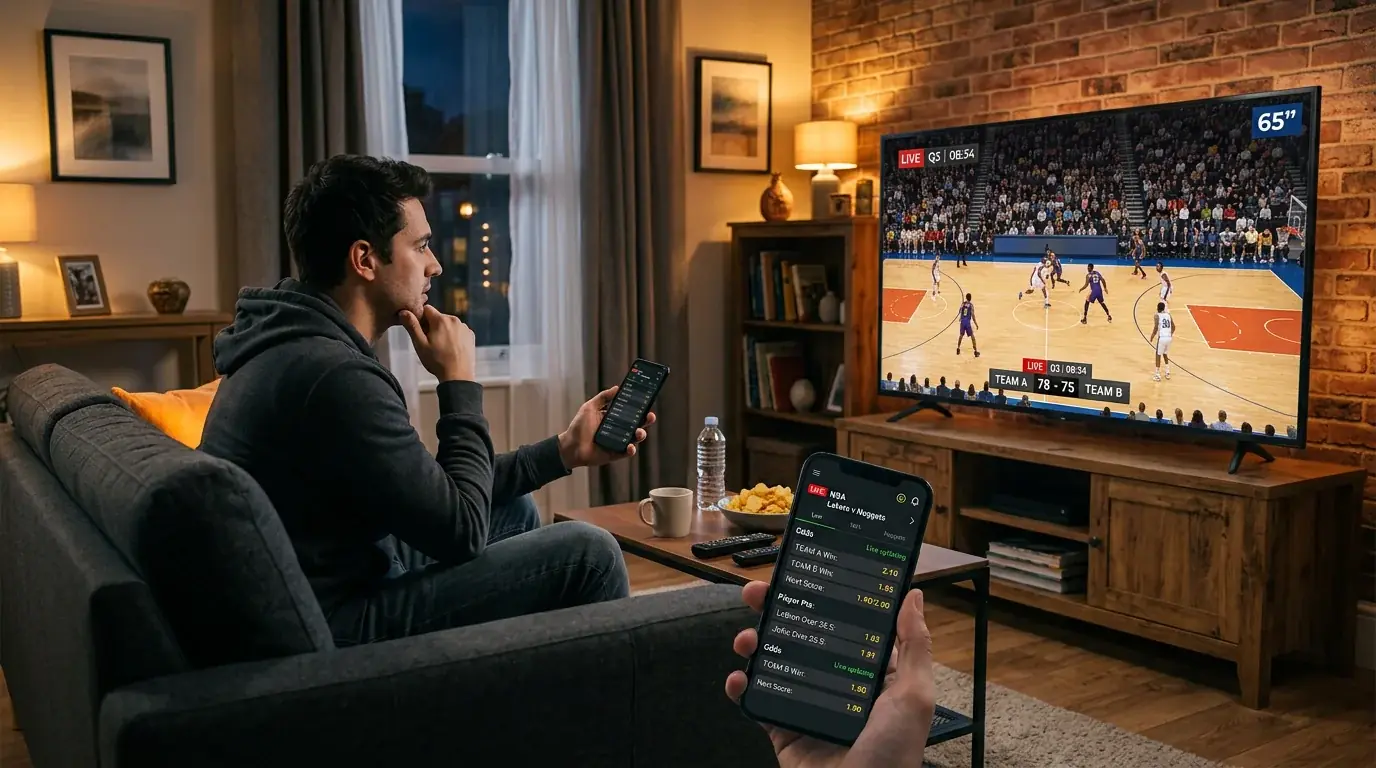
Live NBA prop coverage in the UK improved noticeably between the 2023–24 and 2025–26 seasons. Major operators now post live points, threes and rebounds props on most national-broadcast games, with suspension windows during free throws and timeouts. The bigger live-betting question is reaction discipline — chasing in-play bets without a pre-game projection in mind is a fast way to bleed money.
UK accounts default to decimal odds, which makes price comparison faster than the American format. A line of over 22.5 points priced at 1.91 on Operator A and 1.95 on Operator B is a four-tick difference that compounds across a season. Opening two accounts for the express purpose of price-shopping is probably the single highest-EV behavioural change a casual UK prop bettor can make.
Note: UKGC licensing is the floor, not a sign of quality. Always confirm an operator's licence status on the Gambling Commission's public register before depositing.
For a more granular comparison of coverage criteria across the major UKGC-licensed bookmakers, work through the operator coverage comparison piece.
Betting NBA responsibly when you live in the UK
I've written about NBA props for over a decade and the conversation that comes up most often in private messages isn't about hit rates or pace adjustments. It's people asking how to know whether they're betting too much. The honest answer is uncomfortable: if you're asking, you probably are.
UK gambling regulation has moved firmly toward consumer protection over the past five years. The 2025 statutory levy, the 2026 Remote Gaming Duty rise, the GambleAware research showing 19 percent of young adult gamblers exceeding the problem-gambling threshold — all of it points to a regulatory direction that takes harm seriously. The product side responds with self-exclusion tools, deposit limits, time-out functionality and prominent links to support resources.
The UK statutory levy fund of roughly £120 million annually distributes through three pillar bodies: NHS England for treatment, OHID for prevention and UK Research and Innovation for research. The shift from voluntary to statutory funding doubled the previous £40 to £60 million annual contribution range.
Practical safeguards I actually use
Deposit limits set monthly, not weekly — the monthly horizon matches your bankroll-management thinking better and is harder to game. Reality-check pop-ups every 30 or 60 minutes — they sound annoying because they are, and the annoyance is the point. Self-exclusion options ranging from 24 hours to permanent through GAMSTOP, the UK-wide service covering all UKGC-licensed operators. And — most underrated — a betting log that tracks every prop, the projection, the price taken and the result. Without a log you can't measure whether your edge is real or imagined.
Tip: If you find yourself betting larger stakes to "make up" for losing days, that's the early signal. Stake size should be a function of your projected edge and bankroll, not of your emotional state.
The harassment problem you might be contributing to
This part isn't comfortable to write. NCAA research found that 51 percent of Division-I men's basketball players in a survey of more than 20 000 athletes reported social media abuse tied to their sporting performance. NCAA President Charlie Baker stated publicly that sports betting issues were on the rise, with prop bets continuing to threaten integrity and competition and leading to student-athletes and professional athletes getting harassed. The NBA's player union has voiced similar concerns at the professional level. If you're losing a prop, the player isn't the reason — the line, your projection, or your discipline is.
Setting limits is not weakness. Treating prop betting as entertainment with a stake budget is healthier and more sustainable than treating it as a side-hustle income source.
Questions UK punters keep asking me about NBA props
What are NBA player prop bets and how do they work for UK punters?
A player prop is a wager on whether a named NBA player's individual stat output (points, rebounds, assists, threes, blocks, steals, or combinations like PRA) will land over or under a specific line during a single match. It's settled on what the player records, regardless of who wins. UK accounts price these in decimal odds — a typical line might show 1.91 over and 1.91 under against a points line of 22.5.
Which NBA player prop markets historically have the highest hit rate?
Based on graded prediction data through the 2025–26 season, blocks props have hit at 69.9 percent, three-pointer props at 63.2 percent, steals at 61.9 percent, assists at 57.6 percent, rebounds at 57.3 percent and points at 55.7 percent. Higher hit rates don't automatically mean higher profit — pricing matters too. Match the hit rate to the price you're getting before deciding which markets to focus on.
How do UKGC-licensed bookmakers price NBA player props compared to US books?
The maths is identical — both use overround as the bookmaker's margin — but the format differs. UK accounts show decimal odds (1.91/1.91) where US books show American odds (–110/–110). Both reflect roughly 4.8 percent overround. UK menus tend to be slightly thinner because NBA is a smaller market here. Vig on standard markets sits in similar 4.5 to 5.5 percent ranges across major UKGC operators, though milestone markets carry significantly higher margin.
Why is decimal odds the better format for stripping vig in NBA props?
Decimal odds let you calculate implied probability with one division: 1 ÷ decimal price = implied probability. For 1.91, that's 52.4 percent. Add both sides' implied probabilities, subtract 100, and you have the overround. American odds require more cumbersome conversion. For UK punters working through prop research at speed, decimal makes the no-vig calculation a few keystrokes rather than a multi-step exercise.
How do UK bookmaker rules treat overtime and early exits in NBA player props?
Most UKGC-licensed operators include overtime stats in player props by default — a points line of 27.5 covers regulation plus any OT periods. Markets explicitly labelled "in regulation" or "first quarter" carve out specific periods. Early exits due to injury are handled differently across operators: some void the bet if the player fails to meet a stated minimum-minutes threshold, others settle on the actual stat regardless. Read the rules tab before betting.
Why have certain NBA prop bets been restricted after the 2025 betting scandal?
The October 2025 federal indictments of 34 individuals — including Chauncey Billups and Terry Rozier — accelerated reforms that had been building since the Jontay Porter case in 2024. Major operators removed under-prop markets on two-way and ten-day contract players because their financial profile (a $636 435 salary for 2025–26) made them vulnerable to manipulation. The NBA also introduced a mandatory 11:00 to 13:00 injury report window with 15-minute updates.
Are NBA player props legal in the UK and which operators cover them?
NBA player props are legal and widely available through UKGC-licensed operators. Every major UK bookmaker that offers basketball coverage carries standard NBA props and most carry combined markets like PRA and bet builder functionality. Coverage depth varies — top-tier accounts post 20-plus markets per starter on premium games while mid-tier accounts post fewer. Always check that the operator displays a UKGC licence number and appears on the public Gambling Commission register before depositing.
The pre-tip-off routine I'd hand a friend starting today
If a friend asked me what to do tonight before betting their first NBA prop, I wouldn't send them a strategy paper. I'd send them a five-minute pre-tip-off routine. Most of the punters who bleed money slowly aren't getting beaten on analysis; they're getting beaten on missing one obvious step in a sequence that should be habit.
Pre-tip-off routine
- Check the injury report at 13:00 local time, every game day. Status changes between 11:00 and 13:00 set the prop board for the night. Don't bet a prop on a player listed "questionable" until you see the noon update.
- Confirm minutes floor. Pull last 5 and last 10 game minutes for any player you're betting. If the average is below the threshold for your projection, pass.
- Run usage rate against opportunity. Did a teammate get ruled out? Has the lineup change been priced into the line yet? The window between injury news and line move is your single biggest edge.
- Check pace and DvP. A high-pace matchup against a soft DvP is the cleanest ceiling for counting-stat overs. Low-pace, tough DvP is the cleanest floor for unders.
- Strip the vig. Calculate the no-vig fair price across at least two UKGC-licensed accounts. If the gap between your projection and the no-vig price isn't at least three percentage points, you have a hunch, not an edge.
- Set the stake by formula, not by feel. A flat stake per bet, sized to your bankroll, is more disciplined than scaling up on confidence.
- Log everything. Date, market, line, price, stake, projection, result. Without a log, you'll remember the wins and forget the losses.
Prop betting in the UK is a probability problem, not a prediction problem. The framework we covered — minutes, usage, pace, defensive matchup, vig — is what converts the daily flood of two-hundred-plus prop lines per game into a manageable shortlist. Run it consistently. Bet selectively. And remember that the 2025 regulatory landscape, from the statutory levy to the Remote Gaming Duty rise to the post-October prop reforms, is reshaping the economics of every line you see.
Created by the ”nba Best Player Prop Bets” editorial team.